Philosophy of the gods, part 1

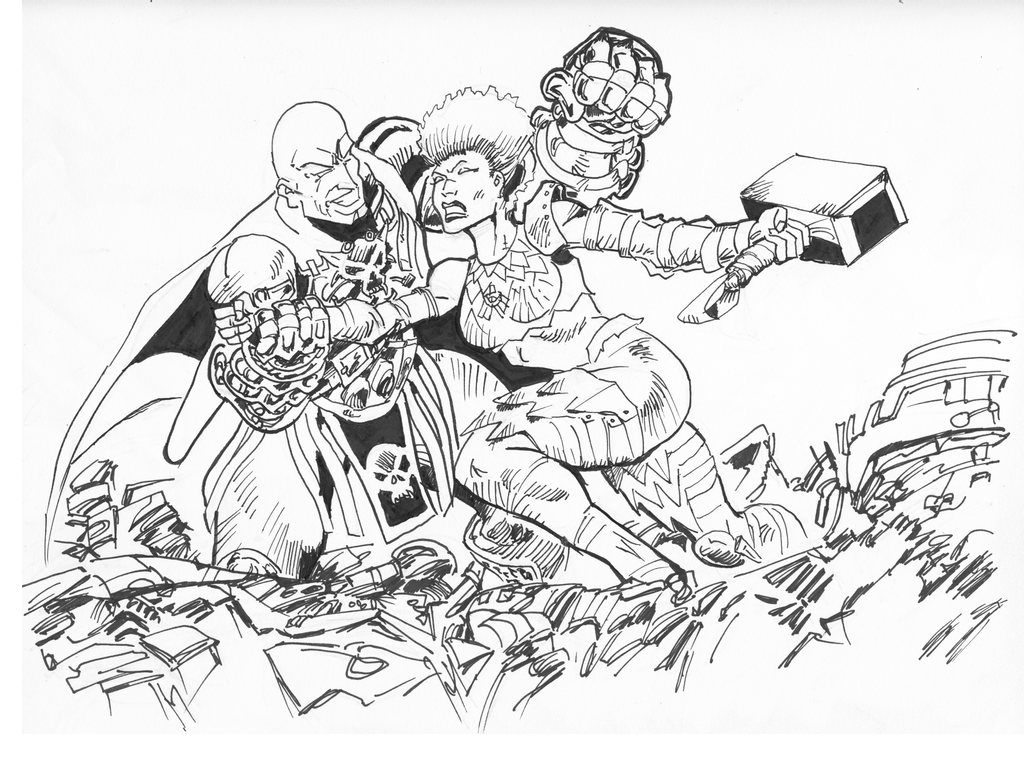
Kaeli vs elder god Orcus, by Awet Moges

In this blog I will be drawing a distinction between two philosophies – one espoused by Kaeli and her guru, Cartaphilus, and the other, by the Elder gods. (Click here for Part 2) Hopefully this will explain how Kaeli’s worldview compares and contrasts with those of the elder gods.

The insurgents
Kaeli’s innermost beliefs are buttressed and articulated by the radical ideas of the anarchist, Cartaphilus. The elder gods, on the other hand, serve as the antithesis to her defiant stand, as the wizened cynics who disdain the fervor of youth. Continue reading Philosophy of the gods, part 1

Disability redefined

The very basic function of the concept called “disability” has perplexed me for decades. Why is it automatically given a negative connotation when thought or spoken out loud? Why do we teach our children that it’s inappropriate to look at a disabled person rather than encouraging them to inquire freely? It seems to further ingrain the lesson that disability is something to be avoided rather than approached as an opportunity for learning.

For the sake of brevity, I will focus solely on the World Health Organization’s (WHO) definition of disability which states:
“Disabilities is an umbrella term, covering impairments, activity limitations, and participation restrictions. An impairment is a problem in body function or structure; an activity limitation is a difficulty encountered by an individual in executing a task or action; while a participation restriction is a problem experienced by an individual in involvement in life situations. Thus disability is a complex phenomenon, reflecting an interaction between features of a person’s body and features of the society in which he or she lives.” 1

I propose a different definition for “disability”: “opportunities unrealized”. Continue reading Disability redefined

Decline and fall of a great club

Greetings, everyone. I bring you sad news. My book club, that unique mix of professionals and literati, has reached a crucial point in its 6 year history.

Let me give you a bit of background: the book club was founded by a couple of deaf bookworms who wanted to discuss books in their native sign language. Soon enough, my sister joined and I followed not long after. The membership stayed roughly at around 6 to 8 people. We struck a near-perfect balance between a linguist, a lawyer, a historian, an activist, a psychologist, and a heretic.  However, about a year ago, more and more members started to join. By last summer we had balooned to 14 and decided on a cap. Sure enough, by fall a couple of people stepped down (moved away or leave of absence) and that opened up roster spots.

Now, a middle aged man was recruited to join but to the general chagrin of the club. I won’t go into personal details – but suffice to say that his addition somewhat skewered the chemistry. Now, for the final spot, I proposed a great candidate (in my opinion but I’m sure she qualifies much better than the other guy) but she had one drawback. She wasn’t deaf by nature. However, she was born to deaf parents, and her first language was sign language. That should have been good enough of a counterargument in itself.

Not to several fundamentalists, unfortunately. They wanted an exclusive all-deaf club. That in itself isn’t a bad idea, given that there are thousands of book clubs out there in the greater metro area we can’t participate. But that bothered the hell out of me – we participated through the use of sign language, not because our audiogram passed a certain level of hearing loss.

After I submitted a petition for the coda (child of deaf adult(s)) citing her merits (she’s involved in the community, has a fantastic personality, well-read, etc) the members voted on her. Some were for, others were against (due to a dubious argument that her profession as an interpreter could lead to conflicts in the future). Battle lines were drawn, blustery emails were fired, ideologies were spouted, etc. The vote was suspended for the next meeting.

Now, my feeling is that the hardliners will dig in, ignore all charges of reverse audism, and with numbers, reject the coda’s application. My sister will then write a card that says “HYPOCRITE,” and then tell everyone that she doesn’t want to be one, and resign. Then some of us will follow her out of the door and set up our own inclusive club.
You don’t have to be a cynic

Diogenes, by John William Waterhouse

Becoming a cynic is not an indication of a failure of character, or an anomalous individual event in today’s culture, for it is actually symptomatic of modern culture. Cynicism is essentially the result of the Enlightenment, which spelled the end of Christian dogma by destroying its ideals, absolutes, truths. As the Enlightenment progressed in its demystification of ideals, nihilism emerged form its wake. But one ideal was spared: the subject, which grounded all critiques and including positive ideas like Kantian ethics.

Prior to the Enlightenment, Christian metaphysics was true (i.e., the bible holds truths, the word of God, etc.). But the Enlightenment brought to the end to all that with critiques that decimated these aforementioned absolute truths. However, where the enlightenment has been a “melancholy science” (pace Adorno) it only exacerbates melancholy. We need something that doesn’t depress us and sinks us into cynical reasoning. We need a new critique that’s also a gay science, as opposed to the sad sciences of the enlightenment that took away all the ideals we used to believe in. Sure, this critique is also an attack, but it holds an attitude against making people miserable or depressed. Continue reading You don’t have to be a cynic

TOP 10 FILMS OF 00’S

I haven’t seen every movie that’s worth watching, and I doubt I could legitimately rank the great movies according to a single value scale, without being unfair. I started with about 40, and it took forever just to whittle it down to 10.


10. Memento

Most gimmick movies hardly rise above their gimmick, but Memento successfully pulls it off. Memento is a mesmerizing tale that depends on YOUR memory, and takes full advantage of the distinct nature of cinema with multiple narratives. Guy Pearce has never surpassed his role as “Leonard Shelby from San Francisco.” A breakout hit for Christopher Nolan that unleashed a career full of great movies. Continue reading TOP 10 FILMS OF 00’S

Deconversion

by Chris Madden

I don’t have a dramatic story to share: my deconversion was a slow process that began in childhood. It began when I, a bored catholic boy started to discuss religious matters with a young child of a Jehovah Witness family. We went over the differences in our religions, but even then, I could tell that his faith limited the bounds of our discussion, and that I had hardly any of my own. I remember asking Matt which bible he used, and he simply declared it to be the first one. I did not press matters there, and did some researching of my own. I asked his mother if I could borrow those short books they had around the house and I enjoyed reading the extensive explanation in their stories that expanded the bible stores. Lovely paintings. Of course my mother didn’t like this and insisted that I study our religion before I start to investigate others, and of course I readily ignored her advice. Continue reading Deconversion

A dogmatic view of the Two Dogmas

W. O. Quine, by Tim Townsley

In the concluding section of the Two Dogmas of Empiricism, Quine describes our entire knowledge as a “man made fabric,” (Two Dogmas of Empiricism, p. 39) an epistemological system that’s essentially a human construct consisting of statements, but one that’s constrained or limited by the vast accumulation of experience. When new experience that’s not confirmed or compatible with the existing construct occurs, there are repercussions that alters statements within the construct, and in turn, causes a ripple effect that changes other “logically connected” (p. 39) statements. Continue reading A dogmatic view of the Two Dogmas

Carnap and objectivity in science

Rudolf Carnap

In the Logische Aufbau der Welt, Rudolf Carnap was concerned with the objectivity of science, and how his rational reconstruction, could successfully explain why science is objective, despite starting with an autopsychological basis. In section 66, Carnap raises the challenge his system must solve: How can science consist of “intersubjective valid assertions,” (Logische, p. 106) when all physical objects are constructed from subjective experience? Continue reading Carnap and objectivity in science

Mach’s sensations

Ernst Mach

In the Analysis of Sensations, Ernst Mach attempted to categorize elements into three groups:  A B C as the independent objects of the world, K L M as one’s own body, and a b c as the contents of one’s own mind. It seemed trivial to extend this chain of relations to other people’s bodies, termed as K’ L’ M’. But once Mach tried to classify other people’s mental contents as well, as a’ b’ c’, he realized that this analogy had taken him far from the comforts of direct perception (one perceives other objects, and is capable of perceiving one’s own body, and one has one’s own thoughts) to  inferential assumptions, a much less certain form of knowledge. Mach’s description of “plunging into an abyss” (Sensations, §8, p13)  invokes the problem of other minds. Continue reading Mach’s sensations

Kant’s paradox

Square Paradox

The paradox Kant raises in the Prolegomena to Any Future Metaphysics, §13, is that two intrinsically alike objects must be interchangeable. However, some objects are exactly intrinsically alike, but they’re not interchangeable. He noted that his right hand is virtually identical to its image in the mirror. However, he could not replace his right hand with its mirror-image. He then proceeded to state that he could not think of any “internal difference” (Prolegomena, p. 37) between his right hand and its image in the mirror. Yet he could sense the difference between them for they were not truly congruent. Continue reading Kant’s paradox