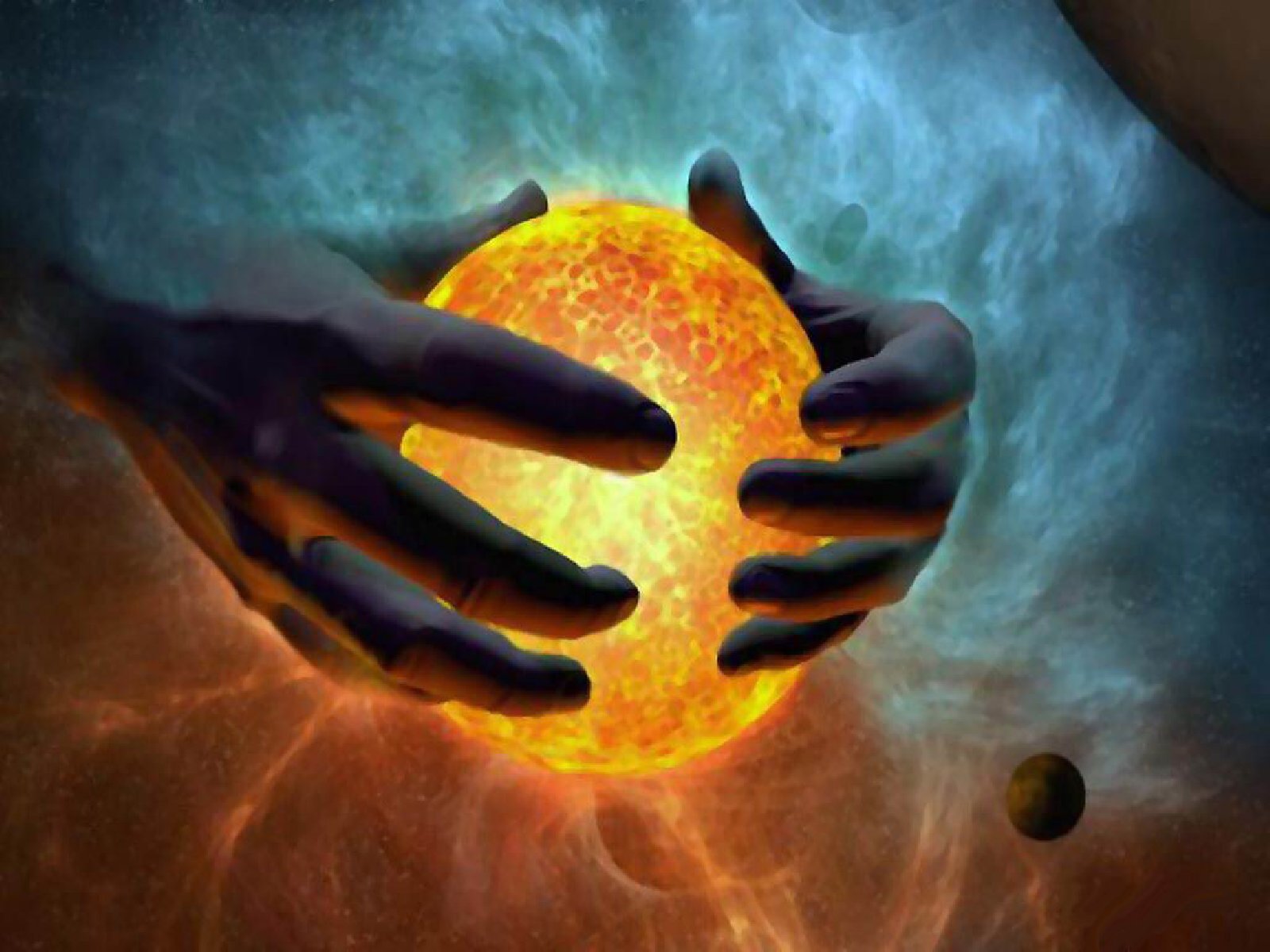
Nothing.


Every ‘why’ question is a subset of the ultimate question: Why is there Something and not Nothing instead? If you can think yourself and the world away, if you can say no, then you are acting in the dimension of the nothing. There is such a thing – the Nothing. We are, Heidegger says, “a placeholder of the nothing.” (What is Metaphysics, p. 38) The transcendence of human beings is therefore Nothing. Continue reading Nothing.

Existentialism in Pantheon

I had an epiphany a few days ago: the graphic novel I am working on, Pantheon, is a vampire novel. I mean, it doesn’t obviously share with many traditional elements (blood sucking, undead creatures), but they both feature immortal beings that reflect on our humanity in many ways, and most importantly in an existential fashion. Continue reading Existentialism in Pantheon

Creation, by Gore Vidal

In the beginning…

A historical novel by Gore Vidal, Creation is an Odysseus styled dialectic on religious dogma. The main character, Cyrus Spitama, is the grandson of Zarathustra, and his encounters with other 5th century sages are clearly the highlights of the novel. Cyrus is fixated on the question of creation, or the origin of the universe or human existence. Initially he was indoctrinated by Zarathustra, specifically the dualistic ontology of Zoroastrianism. Convinced with this religious truth, he sets out to test the alternative answers or non-answers of other wise men, such as those from the East: the Buddha, Confucius, Lao-Tze, and the West: Pythagoras, Anaxagoras, and etc. However, the book demonstrates how much of a fatal flaw the question of creation was for Western philosophy, because it always was the wrong question. Continue reading Creation, by Gore Vidal

Other Post-Postmodernisms: a glossary

Confetti Death, by Typoe


The previous blog focused on pseudo-modernism, on whether it was a sufficient successor to the dominant cultural paradigm. In my research, I realized that there were way too many “posts” to postmodernisms that I needed a program to tell them all apart.  Continue reading Other Post-Postmodernisms: a glossary

Pseudo-modernism

Post-post-post-post...
Post-post-post-post…

Is postmodernism really dead, finally, after a thousand articles and books arrogantly, yet prematurely announced its death? Or perhaps tomorrow belongs to it because postmodernism is born post-humously? Kirby made a strong case in his article, Death of Postmodernism and Beyond (2006), in which he claims that the Internet is essentially proof that the zeitgeist has lurched from the text back to the reader — now an active participant in the creation of text. Continue reading Pseudo-modernism

Leopardi and pessimism


Leopardi, wondering if he left the TV on....
Leopardi, wondering if he left the TV on….


Giacomo Leopardi is one of the greatest secrets of 19th century poetry. Despite being heralded by luminaries like Schopenhauer1 and Nietzsche, his fame remains scattered in Europe and hardly extends to the American hemisphere. Leopardi’s Zibaldone di pensieri2 was read by every school kid but they barely cracked open his Operette Morali.3 The likely culprit is an irredeemable pessimism that was too difficult for interpreters to connect it to contemporary issues. Leopardi wrote mostly moral essays, parables, fables, and dialogues – painting life as a joke of the gods – a darkly comic view of world and its inhabitants. However, instead of leaving the reader sad and pathetic, they are actually funny.  Continue reading Leopardi and pessimism

Evangelion 3.0 You Can (Not) Redo

Evangelion 3.0 shinji WTF
WTF?!?

Impressions: WTF. Yes, much like others, I was left speechless. I couldn’t make heads or tails of what the hell I saw. The last time I had that disconcerting feeling was the first time I watched End of Evangelion. Given the amazing levels of awesome Evangelion 2.0 You Can (Not) Advance reached, I was geeked for more of the same, but I was left reeling with confusion, full of questions, and a slow burn that ended in anger.

Continue reading Evangelion 3.0 You Can (Not) Redo

Leibniz & God

In his philosophical system, Leibniz tried to juggle God and the monads. He claimed that monads are both eternal & indestructible, yet also with the same breath, he claimed that God is capable of creating them or destroying them in a jiffy. Monads are supposedly free, which is a must for all substances, but not so in God’s eyes.

Now, just exactly what is God in this system of monadology? Is God a monad Himself? Leibniz only goes far enough to assert that God is the “monad of monads.” Interesting, isn’t it?

If God isn’t a monad, then that would explain for God’s existence before he “flashes” the monads into existence. However, that means monads exist, and consists of properties only in virtue of the properties of this flashing, non-monadic entity. Then if monads depends on another entity, then they are not substances. The definition of substance is something that does not depend on anything else to be what it is. If monads depends on God, then they are only “modes” of a substance. If God is the only entity that does not depend on anything else to be what it is, then God is the only substance.

Hegel observed this: “There is a contradiction present. If the monad of monads, God, is the absolute substance, and individual monads are created through his will, their substantiality comes to an end.”  (Lectures on the History of Philosophy, 3rd section)

If God is not a monad, then Leibniz is basically a Spinozist:doh:

On the other hand, let’s say the “monad of monads” is a monad. However, if God is a monad, then by definition he cannot interact with other monads, or he would determine their essence, and/or they, his. At best, God as monad may be involved with his creation only virtually, which is the pre-established harmony Leibniz often writes about. Thus, if God acts through this pre-established harmony, then he could not have created that either. FWIW, whatever God does, it follows with absolute, logical necessity from his monadic essence. The idea that God will “create” this universe is already contained within the concept of God, much like “got shot in Dallas” is a necessary predicate of “JFK.” Given the hypothesis that to choose one monad is to choose the entire universe, then therefore, once God exists, then the universe such as it is, exists with utter necessity. God could not have had a choice about anything – except like JFK, he is ignorant of his true nature.

Bottom line: if God is a monad, then he isn’t God, but someone like us. If God is a monad, then Leibniz was an atheist. :eek3:

Philosophy Can [Not] Change You

If philosophy cannot guide our conduct, much less change behavior, then why should we bother read philosophy at all? Curiosity, perhaps? If philosophy can help guide conduct, then let’s look at conduct. At the bare minimum, our actions are the result of character, which is what we fundamentally will as motivation. Then it follows that a change in motives will result in a change in action. Then it is reasonable that philosophy can at least produce a change in the information we have about the world that is relevant to how we act.

Continue reading Philosophy Can [Not] Change You