I have been thinking about the best or most appropriate way to tackle the relationship between Christ and the gods of Pantheon, and recently I came across a potential approach in Sloterdijk’s “Cabinet of Cynics” chapter from Critique of Cynical Reason where he goes through the five embodiment of cynicism through history. The first suspect is none other than Diogenes, who embodied the low theory version in his decided opposition to the all-too serious discourse of Socrates & Plato. Kynicism was based on the animal nature of man, where the gestures of the body were framed as arguments (farting or shitting or whacking off in public). In other words Diogenes poked fun at his grave opponents, but instead of talking against such idealism, he lived in opposition in an anti-theoretical, anti-dogmatic and anti-scholastic way. Continue reading Pantheon and Christ
Best anime of 2012

After reviewing the best of anime of 2011, I realized that ranking great masterpieces was a disservice to each other, and to everyone, so I decided to pick only the best two of each season, and leave out the subjective, inconstant ranking. As always, they are based on my mixture of subjective preferences of philosophical depth and aesthetics appeal, but I try to leave room for the unexpected, which allows me to learn how to enjoy despite my worst habits. Continue reading Best anime of 2012
Lucky 7
Luck*y sev*en (luk’ sev’ n) n. The renegade bunch of self-proclaimed party animals of south California; group of rapscallions that gained notoriety through reckless mischief and endless hype during the late 90’s.

Founded by Drizzit, Ez, Noid, Doughboy, Stinky, and the Wizard, the Lucky 7 was a counterculture phenomenon. Countless recruits dogged the L7 to be included, to get a piece of the glory or at least share the peripheral benefits. Their code is to raise hell and increase mayhem by getting as messed up as possible, which was in demand for deaf social functions for the 20 something year olds … Continue reading Lucky 7
Psychopaths: Moral Deviants or Harbingers?

I first learned of the idea of a psychopath in Thomas Harris’ thriller, the Silence of Lambs. Hannibal Lecter was a deeply fascinating character, and all the more frightening because he didn’t look like a grotesque monster, a violent & bloodthirsty beast. Instead, Lecter was a charming and intelligent character with a doctorate in psychology, but utterly conscience-free. His hypothetical existence forced me to reflect and sound the depths of darkness within. However, psychopaths remained only a curiosity until this quarter, when I came across the idea of psychopaths again in the works of moral philosophers. In this essay, I shall summarize the main arguments of Nichols and Kenneth regarding the danger that psychopaths pose to moral reasoning. Then I shall argue why neither passes muster, for they remain trapped within the tradition of philosophy as a meta-psychology, and why psychopaths are potential harbingers of the future. Continue reading Psychopaths: Moral Deviants or Harbingers?
Shortcomings of “New Atheism”
There’s an ugly aspect to these “new atheists” I’ve encountered over the years, whether online (Internet Infidels) or in person: speculation is anathema to them.
Like many in academia or in the sciences, they accumulate huge amounts of data and information from studies and statistics, but they’re too cowardly to venture to speculate on the larger ramifications of this information or try to connect it all into a theory. Why? Continue reading Shortcomings of “New Atheism”
Pantheon update
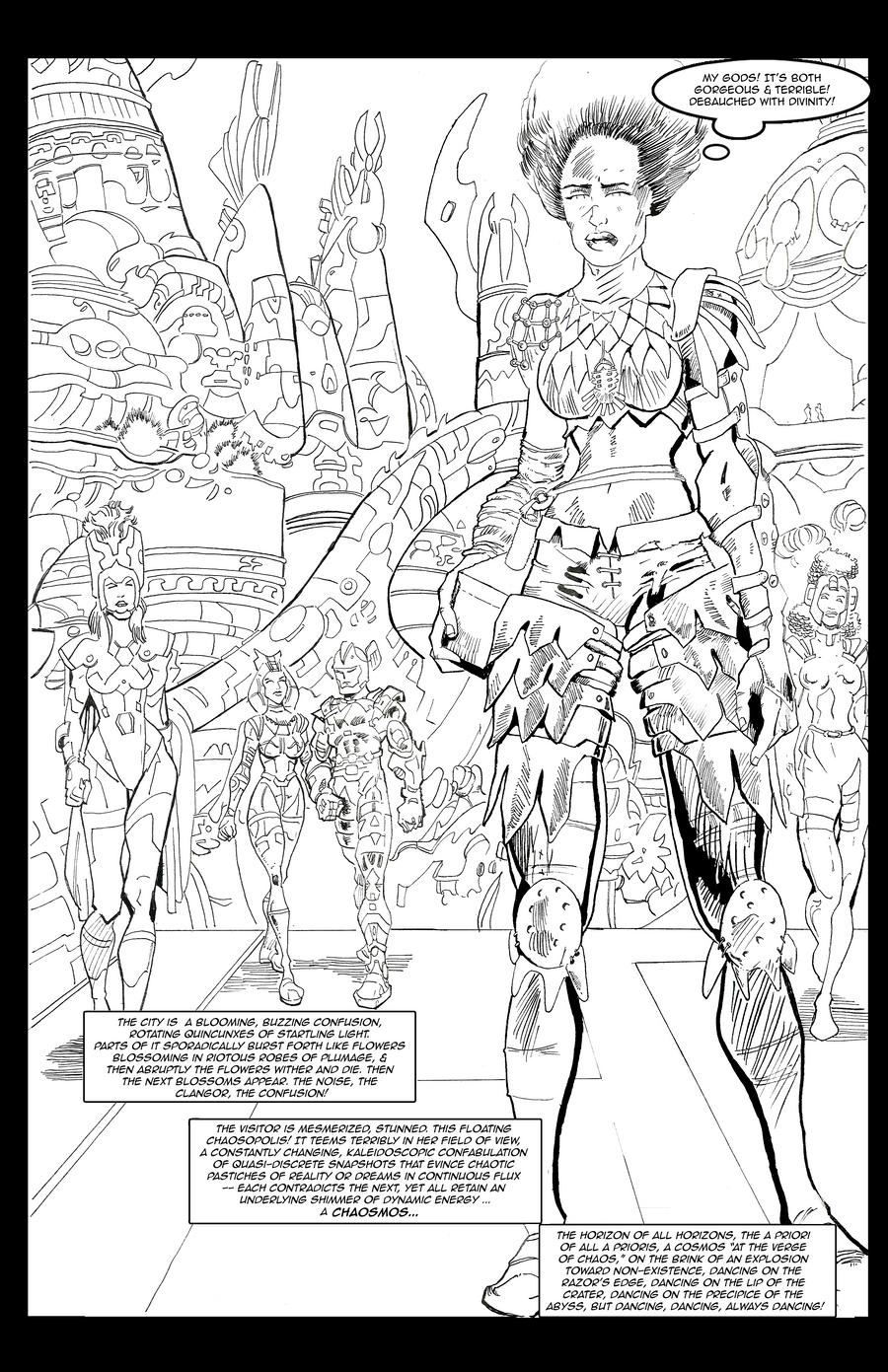
I have compiled chapters 1 – 3 in pdf, and are available upon request. Here are pages one from chapter 2 and 3:
Chapter 2:

Chapter 3:
Are all opinions of art equal?

When it comes to art and opinion, we are always reminded of the latin maxim: De gustibus non est disputandum (There’s no disputing taste). However, in the anime Hyouka (13th episode) the issue of art and subjectivity is raised by two high school girls, between Mayaka Ibara and her senpai, the president of the manga club. Continue reading Are all opinions of art equal?
Fate/Zero and nihilism

While I’ve read several works in literature that could pass as nihilistic, it wasn’t until Fate/Zero I could say I’ve come across a truly nihilistic masterpiece. Even the classic Neon Genesis Evangelion did not reach this nadir of such depraved nihility. Gen Urobuchi, the writer of Fate/Zero has expressed similar sentiments in his other works such as Puella Magi Madoka Magica, but Fate/Zero serves as a platform that displays a potpourri of various philosophies that are exposed one by one as fictitious or illusory.
Master Vice: Hypocrisy

In this blog I will analyze how hypocrisy is a master vice that includes three of the new seven deadly vices – humility, self-deception and prudery.
Hypocrisy is the respect vice pays virtue. – La Rochefoucauld
Hypocrisy is essentially an action where one pretends to hold clear and recognized set of values or attitudes but actually doesn’t. Despite choosing vice, the hypocrite understands that virtue is superior and assumes its facade. Therefore, the hypocrite is not being dishonest about good or evil, but rather himself. Continue reading Master Vice: Hypocrisy
Religion of Immortals (Pantheon speculative fragments)
For the next volume in the Pantheon series, I will focus on an alien race that lives on the gas giant that orbits the star Arcturus. They acquire the Tree of Life from the Garden of Eden, which causes them to become immortal, as well as transform their entire world into a lush paradise in eternal bloom.

New religion of Immortals
Not only did the Tree of life turn the sentient species Arcturians (of the planet in the Arcturus system) into immortals, it also abolished individuality. A Christ-like figure was responsible for implanting the seed of the tree of life, and gave up his life, only to be resurrected. However, this did not turn him into the son of god, the messiah, for the tree of life actually turned the entire race into a Christ-like symbol. Continue reading Religion of Immortals (Pantheon speculative fragments)