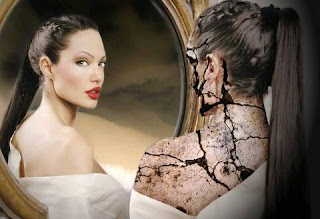
Ekchuah

An amorous, consummate libertine who has lived the luxurious life and experienced all sorts of pleasures, retired from the violent days as the former Mayan god of war. On the surface Ekchuah is cynical and jaded, but his sophisticated veneer conceals a sentimentality he has always kept in check. He longs for his reckless youth, and desires it in others. He preys on the younger goddesses, and loves to chase them especially when they resist. No longer entertaining the illusions of his heyday Ekchuah is currently working with the bounty hunter Orcus these days.

The gods wear masks, for they are all in self-deception. They have buried their thoughts deep in order to appear polite and pleasant to one another. The clever ones like Ekchuah realize that they can uphold conventional behavior and spout platitudes entirely in line with the orthodoxy, at no cost to their true beliefs. Ekchuah blends in with the others, and is left alone with his dangerous thoughts, discreetly sharing them with certain others without any cost to his reputation. Sometimes Ekchuah spreads his thoughts indirectly, with irony and insinuation.

Ekchuah is notorious for his double-dealing ways. Often infiltrating his enemies’ ranks, and working from within to bring the system down, Ekchuah does not give them anything to see or react against. He has learned that he does not have to fight someone who has what he wants. Hence, he joins them and waits for the perfect moment to stage a coup d’état.

Instead of revealing his position publicly that informs the opposition of his intentions, Ekchuah  suppresses his desires to act out hostilities. Whosoever gains in publicity and feels good about expressing themselves openly loses in a reduction of their ability to inflict true damage.

He appears on the enemy’s side where he gathers valuable information (weaknesses or incriminating evidence). Subtle maneuvers such as distributing false information or persuading the enemy into self-destructive behavior result in untold damage far greater than any outside attacks could produce. By ostensibly playing the part of a loyal enthusiast, Ekchuah’s true and hostile intentions are easily concealed. Being undetectable means there isn’t any limit to the destructive powers in Ekchuah’s grasp.

Orcus

Orcus

“…a single-minded pursuit of flagons, feasts, and fornication.”
Known as the former roman god of the underworld and an erstwhile punisher of broken oaths. He used to represent the evil and punishing side of Pluto (roman god of wealth) and tormented evildoers in the afterlife. His power is often limited to mortals, which means he has little to no role among the immortals. Mortals hate him, while the society of immortals often ridicule his position.

Clearly dishonest, disloyal, lacking interest in relationships, but in spite of these vices, Orcus represents a sort of exciting danger, particularly for women and goddesses. Continue reading Orcus

Bellona


Truth is a woman; she only loves a warrior. – Nietzsche
As the Greek deity Enyo, Bellona often carried weapons of war drenched in blood, and accompanied Ares, the premier god of war. As the Roman goddess, she was the original war deity. Currently a member of the Senate at Teotihuacán.

A hopelessly self-centered goddess, Bellona is constantly embroiled in drama, for she needs it in order to keep boredom away. She finds comfort and security anathema, and seeks trouble instead. A passive aggressive sado-masochist, pain is a source of pleasure, and Bellona enjoys complaining about such troubles, being the victim. She despises the polite gods, and often argues with them. Bellona has a long history of tragedies and traumas, and is always on the outlook for a new one, consciously or unconsciously. Continue reading Bellona

Skuld the valkyrie


The youngest Norn, she who is called Skuld, ride ever to take the slain and decide fights


Skuld (necessity, or she who is becoming) was originally a sinister spirit of slaughter or dark demigoddess of death who hovered over battlefields and chose warriors to be admitted to Valhalla, the home of Odin’s army. She also held the Norn position, the goddess of fate, but nowadays she serves as a liaison to Teotihuacan.
Skuld in her long existence, has become a master at the game of seduction, where she orchestrates a game of emotional pendulum that swings between hope and frustration. The ability to delay satisfaction is the ultimate art of seduction: when the victim waits impatiently, he is held in thrall. The bait is the promise of reward (formerly, for the mortals it was the glory of Einherjar) – fundamentally, either pleasure or power – but the promise always remains elusive, which actually makes their targets chase Skuld even harder. Continue reading Skuld the valkyrie

None the Wiser

[Thoth, a god of wisdom and current consul of Teotihuacan, journeys to the bottom of Yggdrassil the world tree, in order to discuss with an ancient god of wisdom, Mimir, about the new radical, Cartaphilus, whether to oppose him or endorse him. Thoth removes Mimir’s decapitated head from the Well of Urd.]

Mimir: Who bestirs Mimir from the comforts of oblivion?

Thoth: It is I, son of Ra, and I seek your advice.

Mimir: Well met, Thoth. But we gods of wisdom hardly need advice.

Thoth: Yes, but your wisdom is distinct from mine: it is not as contaminated by the hysteria of contemporary ideologies. All the same, I request your wisdom regarding this new radical, Cartaphilus.

Mimir: Cartaphilus, the impetuous immortal? You have traveled very far just to discuss a misguided liberator.

Thoth: These days, the merest mention of his name is tantamount to political suicide.

Mimir: He reminds me of the original liberator. Prometheus.

Thoth: Indeed. It seems both Prometheus and Cartaphilus share an unhealthy obsession with mortals.

Mimir: Quite. Whereas Prometheus condemned the mortals of Midgard to consciousness with his myopic intelligence, Cartaphilus condemns mortals of the universe with his call of radical emancipation.

Thoth: Hubris is another thing Prometheus and Cartaphilus have in common.

Mimir: The Olympians were prudent to hide the sources of life from mortals. But that arrogant Prometheus decided to reveal them. The irony is that, despite his claims of lucidity, Prometheus ended up being the father of all misfortunes of the mortals.

Thoth: He was always scolding mortals for being too comfortable with original idyll and their lazy conformity to the laws of animal nature.

Mimir: By introducing self-consciousness to the species, Prometheus divided man from the sources of life he used to enjoy. That compelled man to analyze those sources and reflect on their meaning. Consequently, original happiness was replaced with the curse and torments of titanism.

Thoth: Mortals were doing quite well without self-consciousness? They had hitherto been merely drooling apes. You could hardly tell them apart.

Mimir: Yes and yet, consciousness began a spectacle in everyone that ceased only with the end of the human species.

Thoth: Despite all his foreknowledge, Prometheus never anticipated this.

Mimir: A feckless and blundering humanitarian, a deadly philanthropist whose excuse was illusion. Prometheus, by handing man over to history, banished him from the perfect present.

Thoth: We did applaud Zeus for punishing Prometheus, and applauded Heracles for freeing him with equal vigor.

Mimir: At once the first zealot of science, and the worst modernist, his sufferings console man for his pyrrhic victories. As an instigator of indiscretions, Prometheus idealized knowledge and action and consequently ruined existence. This dereliction of knowledge and destructive curiosity ended the golden age.

Thoth: Undoubtedly. But what to do with our modern-day Prometheus?

Mimir: Cartaphilus, like most moderns, is in a hurry to expedite the onset of a utopia and institute it for perpetuity. His impetuousness does not come from anxiety but from the idolization of euphoria, a secret and morbid craving for Hyperborea.

Thoth: He is convinced that his revolution will be the final one.

Mimir: Because he thinks it’s up to him to complete history for all mortals. History belongs to him alone; thus, he must close it. As if Truth has finally has chosen to reveal herself!

Thoth: Has Truth made a great error?

Mimir: Error is but the fate of others. Never Cartaphilus’.

Thoth: Cartaphilus desires victory over his race, his peers, over us gods, and seeks to revise our work and correct its imperfections. He claims that whosoever doesn’t try or doesn’t think it his duty to try, has given up his destiny, from either wisdom or weakness.

Mimir: Pithy sophism. Prometheus tried to one-up Zeus. But Cartaphilus, a soi disant demiurge, tries to one-up us all and inflict the humiliation of a utopia superior to ours. That is Prometheus all over again, Titanism to a whole new level. The desire to equal the gods by stealing our powers.

Thoth: As long mortals are shackled by sin, they will never enter paradise. Thus they must be freed.

Mimir: Cartaphilus and every other utopians are consciously or unconscious Pelagianists.

Thoth: Yes. Pelagius, who denied the fall, rejected Adam’s lapse the ability to indoctrinate posterity. Adam only suffered a personal turmoil, and disgraced himself alone, and didn’t know he would bequeath the human race his flaws and misfortunes. Mortals are born free, good, and lack original sin.

Mimir: That is a very generous observation, yet very false. Pelagianism is the heresy of utopians.

Thoth: Whether consciously or unconsciously, Cartaphilus subscribes to pelagianism, the idolatry of progress. Revolutionary ideologies are its conclusions, in which mortals make up a mass of sentient beings freed from original sin, infinitely malleable and, self-directed, capable of anything.

Mimir: What an optimistic vision of the nature of mortals! There’s no evidence that their nature is any good. Only those with an inferior will are spontaneously good, and the rest must devote themselves to be good. Whosoever succeeds does so only at the cost of efforts that embitter them. Evil is inseparable from action, and therefore, all action is necessarily directed against another person or thing, and at most, against themselves. Mortals will only at another’s expense.

Thoth: So, the only way Cartaphilus could construct a society where mortals never harm one another is if he limited it to anemic ones.

Mimir: The nature of mortals follows a dynamic principle, one that sustains the fever of change and provokes events. If this is absent or removed, then utopia is possible. Mortals are resistant to true happiness, even though they long for the institution of an ideal society that promises happiness. If that takes place, they will suffocate in it.

Thoth: In other words, satiety is much worse than poverty.

Mimir: Mortals need tension and challenges in order to evolve. What could they do with perfection?

Thoth: True. Cartaphilus, as an anarchist is the last and greatest of all pelagians. His freedom rejects all religions, including those of the most progressive gods, and substitutes for them a new variant of worship – self-love – more brilliant and impossible than the existing ones. Cartaphilus curses the religions and demands their abolition because he sees them as an obstacle to the free expression of mortal nature that was fundamentally good. Now it’s because mortal nature was corrupted that religion was born.

Mimir: Were religious instincts to vanish, then mortals would give themselves up to evil without any restriction whatever.

Thoth: Cartaphilus’ idea of destroying all authority indeed remains the greatest ever conceived.

Mimir: Alas, the human race who fathered Cartaphilus is now extinct. But perhaps they had to fade to vanish from current age to validate his theories?

Thoth: Well, we don’t even have the luck of believing in destruction because we gods are already secularized anarchists. Also, we already understood the urgency and ultimately, the uselessness of destruction. No matter how succinct our denials are, we cannot destroy the objects of nostalgia.

Mimir: The dreams of mortals survive our wisdom. Even though they have given up on the geographical reality of paradise, it resides in them a dimension of their original ego. Can they recover it?

Thoth: Cartaphilus is convinced of that possibility if his program becomes a reality.

Mimir: And once they do, will they realize the ultimate glory? It is not their gods they will see but the eternal present freed from becoming, and eternity itself perhaps.

Thoth: The remedy of the ills of mortals resides within themselves, in the timeless principle of their nature. Even if we gods proved this principle to be false, mortals are convinced that some part of them escape duration.

Mimir: It is useless to recover the old paradise or march towards utopia. One is inaccessible and the other is unattainable.

Thoth: The only paradise lies deep within their being. In order to find it, Cartaphilus must have inspected every past and possible paradise, loved and hated them with clumsy zealotry and scrutinized and rejected them all with competent disappointment.

[Silence interrupts them.]

Mimir: You did not come here for advice.

Thoth: You are every bit the god of wisdom. Nothing escapes your attention. Admittedly, I traveled far away from the pretentious and self-serving rhetoric of Teotihuacan to hear the strongest case against Cartaphilus. Yours.

[Thoth bows, and departs.]

Mimir: There is no difference between a god and a mortal who substitute one illusion for another. The fables of golden age are equal to the vapor of utopia.

Stupidity is the only sin

Homer Simpson's brain seen with MRI/X ray.
Self-explanatory.

Elsewhere I’ve mentioned the Greek notion that more pain or suffering is caused by ignorance or stupidity than outright evil. Despite the inevitable objections from indignant moralists, pain and suffering encompasses far more than the mere violations of liberal justice.

Where animals have instincts that guide them, people employ rationality to balance themselves. Although people are also animals, the species instinct is terribly underdeveloped, and once a person abandons rationality, and careening down the slippery slopes of unreason, he or she becomes unbalanced.

One form of imbalance is the mummified concept, the preserved cadaver, the embalmed remains of what used to be a living idea, a tickling sensation, or a brilliant moment. An original insight is captured and mounted on the wall as a well-groomed “belief,” a freeze-fried snapshot of a rich experience, but one that tends to dominate everything else until it becomes the sacred “dogma.”

These comfortable dogmas are medications against anxiety and other uncomfortable moods of existential angst, and vanity and sloth keeps them in circulation.

Philosophy is the antidote to these dogmas, for it is strictly a tool of unlearning. See here and here and here for further explication.

One trick I used to avoid contentment was where a friend and I would take positions we ourselves did not hold and defend them rigorously against the attacks of the other. This was an excellent way of killing time until the women showed up.

Nonetheless, if one wishes to be mediocre, one is happy with his lot in life, and will not have anything to do with philosophy.

La paresse, or indolence

L’Indolence, by Frederick Bridgman

La Rochefoucauld says the least known of all the passions is idleness, yet it is also the most fierce and destructive of all; the evils it causes are concealed. La paresse, or idleness/indolence, is almost as much of an obstacle as self-love (amour propre) is in the search for truth itself. Despite working quietly and sometimes imperceptibly, indolence has the ability to change our lives: Continue reading La paresse, or indolence

Does pleasure consists of positive existence?

Delush!

How can pleasure “lack” positive existence? It is indeed the case that our simple common sense seem to attribute positive experience to pleasure and negative experience to pain, that they are the opposite ends of a sliding scale of experience. Continue reading Does pleasure consists of positive existence?

“Pride does not wish to owe, and vanity does not wish to pay”

La Rochefoucauld

Regarding my previous entry, most people fail to address the force of the argument, which depends on the assessment of pain and pleasure. The insinuation, little more than a cheap handwave, that people who get bored are not creative is easily contradicted by the facts of life. The most creative people i know are also the ones most prone to boredom, (the sharper the intellect, the worse the boredom) more than likely because their intelligence is not so easily satisfied. Creativity provides no immunity to boredom whatever.

Historically speaking, boredom is a 19th century invention that updated the Latin “tedium” and the French “ennui.” Madame Bovary and Awakening both contain protagonists whose boredom killed their will to live.

If a person achieves sustained satisfactions of his/her desires, and because the essence of his/her nature is a restless driving, he/she will find her/himself confronted with an inner emptiness that is brought about by the absence of the only mode in which she/he can exist. This malady is known by many names: anomie, accidie, noia, ennui, existential boredom, is a 20th century characteristic. Schopenhauer says the formula for people to avoid the Scylla of the will and the Charybdis of boredom is “bread and circuses,” i.e., in our modern vernacular, McDonalds and television.

Optimists in general have neither lived long enough nor looked deeply into the sufferings everywhere. The so-called bright future or the great individuals are merely momentary respite from an overall pattern of one objectification of the insatiably hungry will devouring another. If the essence of the universe is to cannibalize itself by proxy through its objectifications in the world as representation, then there must be a continual give and take. Some are eating, some are eaten, and all things eventually suffer the same fate. The cycle ends only when the world as representation ends (the death or inability to represent for any representing subject). The optimist, totally lacking in a metaphysical foundation in understanding the world as representation, has a narrow attitude that is solely concerned with the fate of those who are (for a time) privileged to be eating rather than eaten, and mistake those limited one-sided happenstances as typical of life. Optimists fail to appreciate that for every objectification of the will that temporarily thrives, there are billions of others that must pay the price. If your life during this particular period of life is going gang-busters, the pleasure that takes place requires the desolation of many other objectifications of the will being sacrificed in the process. (depletion of the natural resources, pollution of the environment, disadvantages for future generations). Show me a successful individual, and I’ll show you thousands of others being used or consumed. The suffering and the exploited always outnumber those who benefit. Moreover, the satisfaction of desires in turn produces its own intense dissatisfaction. Malise is followed by death, and for those who temporarily succeed in gratifying their will, poverty, humiliation and debility await. A sober and realistic view of life is truly pessimistic – perhaps extreme, but to think that we are not meant to suffer, that we somehow deserve happiness, or that the world owes us the fulfilment of our purposes, is a mistake. Schopenhauer’s essay on vanity helps us escape these optimistic delusions to a harder view, but also at the same time a more humane one – more realistic, at least. Life has no purpose, suffering is always part of it and its end may be welcomed.

Some may be tempted to argue that Schopenhauer is not a true pessimist because he does not truly believe that there is absolutely no value possible in life. He grants aesthetic contemplation, artistic genius, life of philanthropy, justice, asceticism, renunciation of the will are the supreme value for some of us. Whosoever escapes the will achieves salvation, a state which value is unassailable. Indeed, this does not quite chime with pessimism, if it must mean that nothing is of any value. However, this does not conflict with Schopenhauerian pessimism where nonexistence would be better and this world is the worst possible one. The value of will-lessness is genuine, but only as some amelioration of the worst possible situation. Hypothetically, there could be an even worse world – one utterly lacking in salvation of will-less resignation. Yet, this existence would appear to be so intolerable that nobody who understood it could endure it at all. Not really a possible existence.

Moreover, I think even Schopenhauer’s salvation is deeply pessimistic, if the only possible true value depends on self-renunciation. Resignation or aesthetic quality is the attitude of detachment from the individual that strives for life. If this individual remains what I am in the world of representation and the will to life, what i am in myself, no immaterial soul, no rational essence, no part of divine plan, then what i am is not only worthless but the very obstacle that must be broken down before true value is even glimpsed. Schopenhauer’s solution to the problem of existence is basically a self-loathing that contains the blackest pessimism possible…

All is vanity…

Schopenhauer’s great intuition: human existence is a constant vacillating between pain and boredom. The existence of boredom is more than just evidence of a disagreeable state; it is proof that man is fundamentally unhappy.

“If life possessed in itself a positive value and true content, there would be no such thing as boredom: mere existence would fulfill and satisfy us. As things are we take no pleasure in existence except when we are striving after something..”(Essays and Aphorisms 53 – 54)

The default reaction to bare conscious continuity, being awake but not doing anything, is boredom. This awareness disappears once we institute and pursue a goal, thereby distracting ourselves from the empty or illusory nature of our lives. During those fleeting moments of satisfaction, we return to raw existence itself.

The final irony of pessimism: even if our desires are satisfied, although imperfectly, the outcome is naught but boredom.

Pure consciousness, framed by space and time, consists of nothing, nothing at all. That nothingness allows us to become most intimately aware of the der Nichtigkeit des Daseins, the Schopenhauerian nothingness of existence, i.e., better known as vanity.

While boredom is not as wounding as sheer pain, it is a form of suffering unique to conscious beings. It is the byproduct of an intuitive understanding of the metaphysical situation of man – the existence in time.

Vanity is not to be confused with the Christian view, where all things are empty as opposed to the heavenly. The phenomenal, temporal and conscious world is illusory because it conceals the real yet transcendental world of the will, and Schopenhauer says “the way in which this Nichtigkeit (vanity) of all objects of the will makes itself known and comprehensible to the intellect that is rooted in the individual, is primarily time. It is the form by whose means that vanity of things appears as their transitoriness, since by virtue of this all our pleasures n enjoyments come to nought in our hands” (WWR II 574)

Because the fundamental element of all individual wishes, for Schopenhauer, is the will, then this Nichtigkeit is “the only objective element of time, i.e., that which corresponds to it in the inner nature of things” (ibid)

Consequently, boredom is the correlate of this essential emptiness of conscious experience, something we become aware of once we quit the striving for individual goals and return to the bare model of existence. While boredom is not a byproduct of reason, it is a cognizance of the evanescent quality of all physical goods.

There is an explanation for why the achievements of our individual goals fail to satisfy: our normal/default condition is active suffering, and since pleasure lacks positive existence, the temporary relief of pain results in boredom, which is but merely a lesser form of suffering. In order to escape boredom we institute fresh new goals. Hence, the constant vacillation between pain and boredom where each extreme sends us in a rush toward the other.

Although our constant yearning, striving, struggling is on the face of it futile, it actually achieves a completely different result other than what we hoped for. Even if we do arrive at our goals, they fail to bring us satisfaction, if at all. But during the process, there is a subtle, yet true achievement: the understanding of the futility of our actions. We can perceive and understand the vanity of existence, once the ongoing effort to keep and maintain physical objects turn out to be utterly pointless. Consequently our illusions about the purpose of life is replaced with the shattering truth.

The predominance of boredom only confirms that it is understood. Look at the countenance of virtually every elderly person, Schopenhauer says. It is an expression of disappointment. If the “fundamental characteristic of old age is disillusionment; the illusions which hitherto gave life its charm n spurred us to activity have vanished. We have recognized the vanity and emptiness of all the splendors of the world… We have learnt that there is very little behind most of the things desired and most of the pleasures hoped for; and we have gradually gained an insight into the great poverty n hollowness of our existence. Only when we are seventy do we thoroughly understand the [second] verse of Ecclesiastes.” (Parerga and Paralipomena, p. 494)

Conclusion: for Schopenhauer, boredom is the outcome of the illusions of conscious life.