Best anime of 2011

Mawaru Penguindrum

This will be my first time to attempt a “review” of anime (Japanese animated shows), and I think a good review is the fine line between fan-boy-ism and elitism, one that is honest with passion, but always facing the direction of the ideal anime. Because I’m a johnny-come-lately to anime, the actual best shows I watched in 2011 are Revolutionary Girl Utena, Bakemonogatari, and Bokurano. Continue reading Best anime of 2011

Dialogue of Kings: a clash of moralities

Left to right: Archer, Saber & Rider

I have been enjoying the ongoing Japanese anime Fate/Zero, & episode 11 consists of a dialogue between three legendary kings who expressed philosophical differences about ruling. The interlocutors are Saber (King Arthur), Rider (Alexander the Great) and Archer (Gilgamesh), but the most interesting aspect was the diametrically opposite approach between Arthur and Alexander regarding how to rule. It was fascinating enough to inspire a lengthy rant on morality, Nietzsche, and representation. Continue reading Dialogue of Kings: a clash of moralities

Pantheon cover art colored!

Professional comic book colorist David Delanty took the time to color my artwork, and suffice to say, it blew away my expectations.


The wonderfully rich, intricate command of colors actually makes up for my amateur stuff in many ways: freckles, shirt stains, water reflection, moss growing on the limestone, serene sky, and more.

You can check out the rest of David’s stuff here at deviantart.com: Link

Nietzsche & atheism

from bizarro.com

Nietzsche is often taken as a poster-boy for atheism due to his infamous phrase, “God is dead!” However, that is not a clear endorsement of atheism but rather, theothanatology. In his writings, Nietzsche did refer to atheism and oftentimes in jest. His hermeneutic-psychoanalysis of Christianity led him to be exceedingly critical of atheists, as well as scientists and skeptics. Continue reading Nietzsche & atheism

On reviving the carcass of philosophy

The following are collected tweets (@thanatology) I’ve made in the past month about posthumanism, or reviving the carrion of philosophy:

Once the window to a frozen thanatosphere opens, thought becomes razor sharp enough to slice through the rotting corpse of anthropocentrism.


And the slimy pus of the absolute seeps out and clot into new-old ideas: a heretical Derrideanism that continually savages itself

 is a decadent form of post-Socratic felo-de-se that faces biological contingency w its own blind eyes a Corpse w/o Organs?

Freed from miserly enforcement of rule-bound metaphysical dilemmas, we are stoned by the fumes rising from a chaotic sea of virtualities.

Cynically supercharged w obscene desire for death, we, slaves to cruel directives of base materialism, bottom out in a dark zone of thought — once we see thru the deceptions of life Ego owns up to its pathology, embarrassed with its Macbeth dagger that drips the Earth’s black blood. 

Agitprops of phenomenology, in resurrecting consciousness, merely plunge themselves deeper into the quicksand of their coprophilic narcissism.

Today’s thinkers are mere maggots feeding on the carcass of Brobdingnagians, whose feces will join the deep undercurrent of chthonic thought. 

Crawling out from the bubbling orifice of its decomposing tomb, posthuman thought performs an autophagous Aufhebung as  cannibalism.

A perverse slave of its own meaninglessness, Posthuman Thought gnaws at the root of the Yggdrasil of its own fatuous jurisdiction.

Today our amputated Reason continues to goose-step around calcifying totems of half-baked ideologies, either out of perversity or mockery. 
Vaguely, the subject will re-cohere in the void pried open by the expulsion of Nature out of its hearth, due to revitalized post-idealism.After sprinkling black salt on the wounds of theology, sliced by universal contingency, thought painfully realizes the anorexia of meaning.

Posthuman thought adjusts its peripatetic trail among the gravestones of exhausted theologies in the misty light of the Polaris of nihilism.

Bizarre avatars will usher in new techniques of thought, sporadically evolving fetid rhizomes & decaying yet again in a farcical cycle.Inciting catastrophic predictions, opening a space for self-destructive ideological scrutiny & directing thanatocratic methods, philosophy ends up as a mere choreography of furious, demented & recurring political sequences.

The failure of philosophy of religion

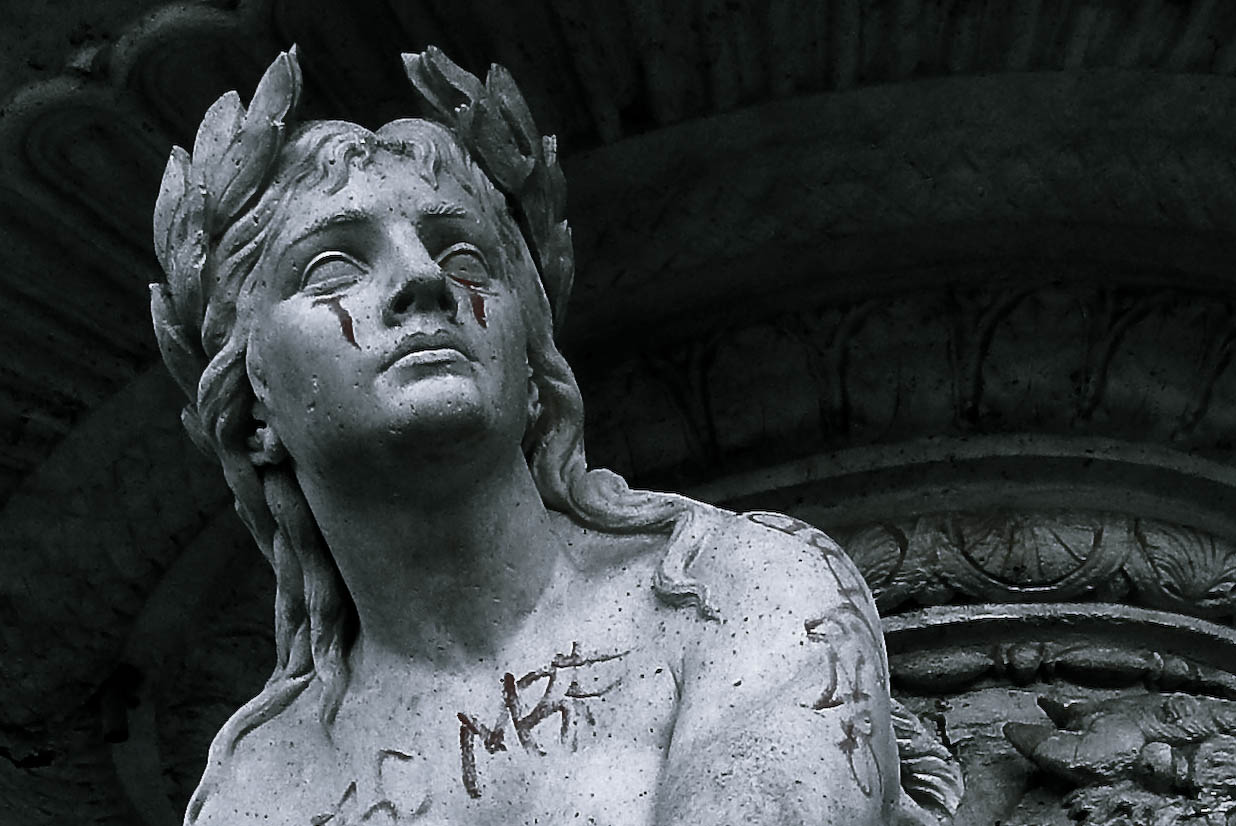
Angel’s Cry

This semester I’m taking a graduate course in the philosophy of religion. I already took one as an undergraduate, but under a different professor who was a proficient expert on Hegel. This time, the current professor seems far more culturally informed and global, which leads to an entirely different angle to assess religion philosophically. Continue reading The failure of philosophy of religion

Being and Time: Part 1, Division 2

Apologies on the late addition. Hopefully it’s not too garbled, and please feel free to discuss anything that strikes your fancy!

§12
Dasein & Authenticity
At first Heidegger says Dasein exists. Sure, sounds great. But that’s just the tip of the iceberg. Heidegger claims that there’s a basic difference between being and existing. Dasein doesn’t JUST exist. It’s that ONLY Dasein exists. Other things, objects like furniture, cars, books, etc., are, but they do not exist in the strict sense of the word. Existence only comes into play with the realization of being. When a being becomes conscious of its own being, it begins to exist.  Continue reading Being and Time: Part 1, Division 2

Being and Time: Part 1, Division 1

Exposition of Task of a Preparatory Analysis of Dasein, or  Bare-Knuckled Brawl with Dasein 

In The first division of part I of Being & Time, Heidegger attempts a transcendental analysis by finding the necessary conditions for some phenomenon – the Dasein – much like Kant did in his Critique where he analyzed objective experience.

He opens the chapter with the first sentence: “we are ourselves the entities to be analyzed.” Continue reading Being and Time: Part 1, Division 1

Being & Time: Introduction (part II)

(for part I go here)

Knee-deep into ontological shit
I feel there’s plenty to mine from the first part of the introduction. :yup: On p. 16, Heidegger says that Dasein has a number of positions:

  • Ontic: the special position is ontic, in which existence determines this being in its being.
  • Ontological: Dasein is itself ontological, based on its existence. Dasein is the ontic-ontological condition of all ontology.
  • Dasein is ontologically primary being that precedes all Being that is the object of inquiry (or questioning).

Yeah, so? This piece is actually quite thought-provoking. That is, if you can handle the number of beings and ontologies and onticalities and existences… :roll: Continue reading Being & Time: Introduction (part II)

Being & Time: Introduction

No self-respecting student of Continental philosophy can speak with any credibility unless they’ve studied the juggernaut of the 20th century Being & Time! I am about to set out on a journey but I may not return the same, if at all. Continue reading Being & Time: Introduction